When a crew plans a heavy lift, one of the first questions on the whiteboard is almost always the same: do we use a spreader beam or a lifting beam? The two devices look similar at a glance — both hang from a crane, both support a load — but structurally and operationally they are very different tools. Choosing the wrong one costs money at best and causes incidents at worst.
This guide breaks down the difference, explains when each device wins, and gives you a practical decision framework your rigging team can apply on the next project.
The Short Version
- A spreader beam is loaded primarily in compression. Slings attach to both ends of the beam and come together above it at the crane hook, forming a triangle. The beam pushes the sling legs apart.
- A lifting beam is loaded primarily in bending. It has a top attachment at a single point (or shackle) and the load hangs from lugs on its underside. The beam bends like a simply supported beam under load.
That single structural difference drives almost every other decision — weight, length, cost, safety margin and application.
How a Spreader Beam Works
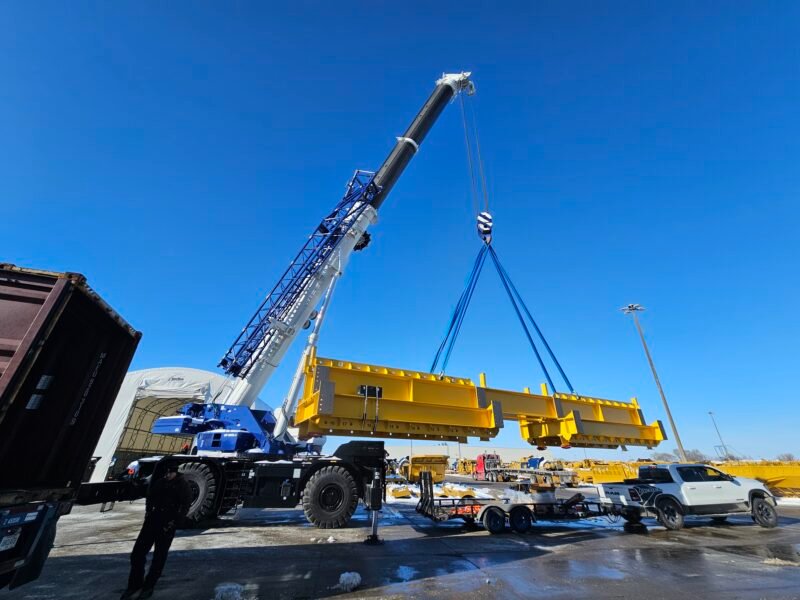
A spreader beam sits between two sling legs. The slings are anchored to the beam’s end fittings and rise at an angle to the crane hook. Because the sling angle is typically between 45° and 60°, the geometry creates a large horizontal force trying to squeeze the beam together from both ends.
That squeezing force is compression. Steel is exceptionally efficient in compression — a hollow tube or box section can resist enormous axial load with relatively little material. This is why modular spreader beams can span 40 feet or more while staying light enough to ship on a standard flatbed.
When a Spreader Beam Wins
- Long loads where total span is 8 feet or more.
- High-capacity lifts (typically 10 tons and above).
- Wide-base machinery, long fabrications, wind turbine blades, bridge sections.
- Projects where the lift plan changes — modular spreader beams can be reconfigured without new hardware.
How a Lifting Beam Works
A lifting beam hangs from a single top pick point. The load attaches to lugs on the underside of the beam, and the beam bends under the load — exactly like a simply supported beam in a structural textbook.
Bending is not as efficient as compression, so a lifting beam for a given capacity and span is heavier, deeper and more expensive than an equivalent spreader beam.
When a Lifting Beam Wins
- Short, heavy loads where the slings would otherwise foul the load.
- Loads that need very low headroom — a lifting beam hangs under a single hook, not inside a sling triangle, so vertical clearance requirements are smaller.
- Multiple-point lifts where the pick points on the load are very close together.
- Loads with a delicate surface where sling contact is unacceptable.
Weight and Cost Comparison
For the same rated capacity and span, a spreader beam is typically 40–60% lighter than an equivalent lifting beam. That difference shows up three times:
- Freight. A lighter beam costs less to ship.
- Rigging capacity. The crane’s own capacity is reduced by the weight of the rigging hardware. A lighter beam means more of the crane’s capacity is available for the actual load.
- Handling. Lighter beams are easier to store, easier to move around the yard and safer to rig on elevated decks.
On unit price, spreader beams and lifting beams are often comparable. The total cost of ownership, though, favors the spreader beam in most long-span, high-capacity scenarios.
Safety Considerations
Both devices must comply with ASME B30.20 (Below-the-Hook Lifting Devices) and ASME BTH-1 (Design of Below-the-Hook Lifting Devices). They must also be:
- Proof-load tested to at least 125% of their rated working load limit (WLL).
- Marked clearly with WLL, manufacturer and serial number.
- Inspected periodically per ASME B30.20 requirements and before every use.
- Used only by trained riggers who understand the specific sling angle, load path and attachment points.
Regardless of which device you choose, the lift plan must be reviewed by a qualified engineer and the riggers must have certification appropriate to the load weight and complexity.
A Practical Decision Framework
Ask these five questions in order:
- What is the total load weight, including the rigging? If the load is under 5 tons, either device likely works — choose based on clearance.
- How wide is the lift? Loads wider than 8 feet almost always point to a spreader beam.
- How much headroom do I have? Tight overhead clearance pushes you toward a lifting beam.
- Will the lift plan change? Variable or multi-configuration lifts favor a modular spreader beam.
- Where are the rated pick points on the load? If they’re far apart, a spreader beam wins on efficiency. If they’re clustered, a lifting beam wins on simplicity.
Common Mistakes to Avoid
- Using a spreader beam rated in tension as a lifting beam. The load path is completely different — it will fail.
- Ignoring the sling angle. A spreader beam rated at 60° sling angle has a very different capacity at 45°. Always check the load chart.
- Skipping the proof load certification. Any beam you use must have documented test certification from the manufacturer.
- Assuming “heavier is safer”. Over-specifying wastes crane capacity and makes handling harder. Right-size the beam, don’t over-size it.
Still Not Sure? Talk to an Engineer
Every heavy lift is different, and a 20-minute conversation with an experienced rigging engineer will save you more than any catalog ever will. Horizon Crane & Rigging’s U.S.-based engineering team answers the phone 24/7 at (815) 763-2754 — call before your lift plan is finalized, not after.
Or request a quote and include your load weight, lift span and rigging configuration. We respond within one business day with an engineered recommendation.
Related reading: