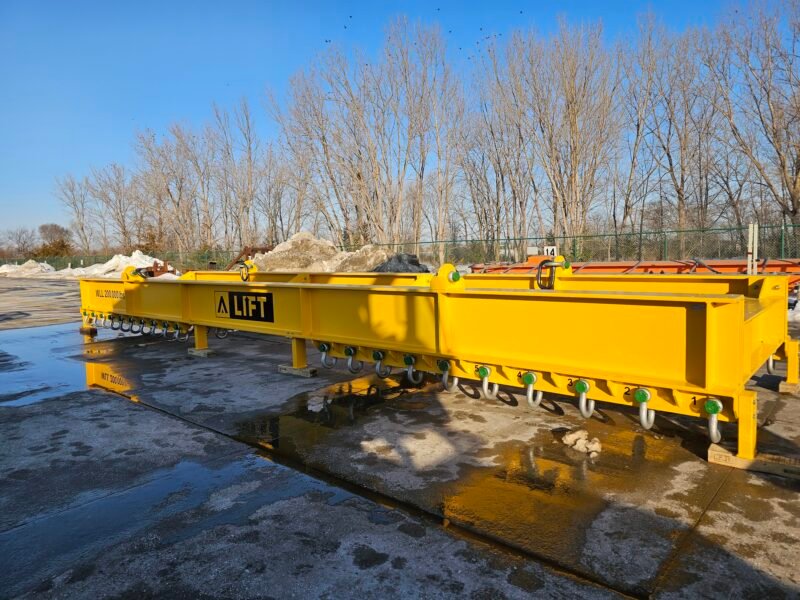
Every spreader beam, lifting beam, lifting lug and modular frame used on a U.S. jobsite is subject to the same federal and industry expectations: that the hardware is designed, manufactured, marked, tested, inspected and used in accordance with ASME B30.20. Ignoring the standard isn’t a technicality. OSHA incorporates it by reference, insurers expect it and every serious general contractor audits for it.
This article unpacks what B30.20 actually says, how it relates to its sister standard BTH-1, and what a rigging engineer or project manager should check before putting a spreader beam into service.
What ASME B30.20 Covers
ASME B30.20 — Below-the-Hook Lifting Devices is the industry consensus standard for devices attached below the hook of a crane, derrick or hoist and used to lift a load. It applies to:
- Spreader beams and spreader bars.
- Lifting beams.
- Lifting frames and traverses.
- Sheet lifters, plate clamps and coil lifters.
- Vacuum lifters and magnets.
- Custom-engineered lifting fixtures.
The standard breaks into chapters by device type. Chapter 20-1 covers structural and mechanical lifters — the category that includes virtually all spreader beams.
The Five Compliance Pillars
B30.20 is long, but its substance can be summarized in five pillars:
1. Design by a Qualified Person
The device must be designed by — or under the supervision of — a qualified engineer working to the ASME BTH-1 design standard (see next section). “Qualified” is not a self-declared title. OSHA treats it as a person with a recognized degree, certification, training or experience sufficient to solve the problem.
For a spreader beam, that usually means a licensed Professional Engineer (PE) with structural or mechanical specialization.
2. Identification Markings
Every B30.20 device must be permanently marked with:
- Manufacturer’s name or trademark.
- Serial number.
- Device weight, if over 100 lb.
- Working Load Limit (WLL).
- Design Category (A or B per BTH-1).
- Service Class (0 through 4 per BTH-1).
The marking must be legible and durable. Paint pen on a tag that falls off in the rain does not count.
3. Proof-Load Testing
Before first use and after any structural repair, the device must be proof-load tested to 125% of its rated capacity. The test must be documented and the documentation retained by the owner for the life of the device.
For a 60-ton spreader beam, that’s a 75-ton proof load — no small event. Reputable manufacturers include the test report in every shipment.
4. Periodic Inspection
B30.20 defines three inspection intervals:
- Initial inspection — before first use on a new device.
- Frequent inspection — before every shift the device is used.
- Periodic inspection — at intervals between 1 month and 1 year based on service level and environment.
Records must be kept for periodic inspections. Frequent inspections are generally a rigger’s visual check each shift and do not require written records unless your company policy says otherwise.
5. Operator Training and Use
The device may be operated only by trained and qualified riggers who understand the device’s load chart, sling angle limits, attachment points, inspection criteria and the contents of the operator manual.
How BTH-1 Fits In
ASME BTH-1 — Design of Below-the-Hook Lifting Devices is the design-side counterpart to B30.20’s use-side rules. BTH-1 tells the engineer:
- What load factors to apply (1.67 or 2.0 depending on Design Category).
- What fatigue life to design for (Service Class 0, 1, 2, 3 or 4).
- What weld quality to demand.
- What steel grades are acceptable.
- How to calculate allowable stresses for bending, shear, bearing and combined loads.
A spreader beam that’s “designed to BTH-1” has been run through these calculations by an engineer and documented in a design report. A beam that’s merely “built to handle 60 tons” without a BTH-1 design basis is not compliant — even if it happens to work.
How to Verify Compliance Before You Buy
Before you cut a purchase order for a spreader beam, request the following documents from the supplier:
- Design certification letter signed by a licensed PE, referencing BTH-1 Design Category and Service Class.
- Material certifications (mill test reports) for the structural steel.
- Welding procedure qualification records (WPQR) and welder certifications.
- Proof-load test report to 125% of WLL, with date, test setup and inspector signature.
- Operator manual and inspection checklist.
- Copy of the identification plate (or photo showing all required markings).
If a supplier hesitates on any of these, find a different supplier. Everyone reputable has this paperwork in a drawer waiting for the request.
Common Field Compliance Failures
Based on real project audits, the most common B30.20 gaps we see are:
- Missing periodic inspection records — the beam was bought compliant but then never re-inspected.
- Incorrect use outside the load chart — using a 60° rated beam at 45° sling angle without derating.
- Field modifications — welding on a new shackle lug without having the beam re-engineered and re-proof-tested.
- Lost ID markings — the tag was painted over or broken off.
- Untrained operators — riggers using the beam without formal training.
Any of these can invalidate compliance and expose the project to OSHA citations, insurance disputes or worse.
The Business Case for Compliance
Strict compliance with B30.20 isn’t just risk avoidance. It is also:
- A procurement differentiator — general contractors increasingly require documented B30.20 compliance in rigging specificationc.
- An insurance advantage — carriers offer better rates to operators with documented inspection and training programs.
- A retention tool — trained riggers stay with employers who invest in proper equipment and paperwork.
How Horizon Ships Compliance
Every Horizon RA-series modular spreader beam ships with:
- Design certification signed by a licensed PE, referencing BTH-1 Design Category B, Service Class 2 (upgradable on request).
- Mill test reports for all structural components.
- Proof-load test report to 125% of WLL.
- Operator manual with load charts, rigging diagrams and inspection checklist.
- Permanent ID plate with manufacturer, serial number, WLL, Design Category and Service Class.
We also offer annual re-certification and re-inspection service for any Horizon beam in the field. Contact us for details.
Further Reading
- ASME B30.20 official product page
- OSHA references to below-the-hook lifting devices
- Our modular spreader beam catalogue
Questions about compliance for your specific project? Horizon’s engineering team is available 24/7 at (815) 763-2754 or request a quote.