
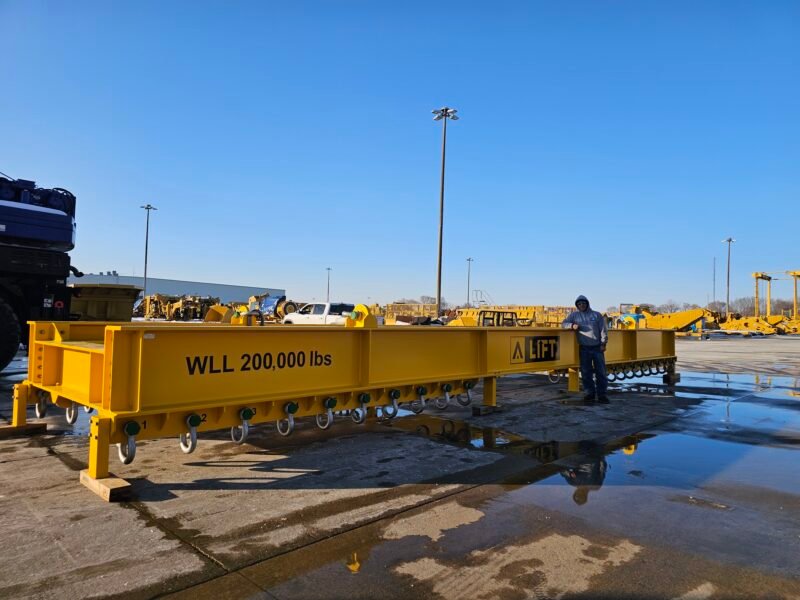
Choosing the right spreader beam is not a catalog decision — it’s an engineering decision. Get it wrong and you over-pay, under-lift or create a safety hazard. Get it right and the lift is almost boring, which is exactly how rigging should feel.
This guide walks through the six questions every qualified engineer asks before specifying a spreader beam. Use it as a worksheet for your next heavy lift.
Step 1 — Nail Down the Total Lifted Weight
Start with the load itself and then add everything you’re attaching to it:
- The weight of the piece being lifted (don’t guess — use drawings or a certified scale).
- The weight of all rigging below the beam: slings, shackles, chains, lifting lugs, tag lines.
- The weight of the spreader beam itself (this is surprisingly large on 60+ ton beams — can be several thousand pounds).
- A dynamic load allowance if the crane will move during the lift (typical is 10–25% for standard cranes, higher for suspended or offshore work).
The sum is your gross lifted weight. The spreader beam’s Working Load Limit (WLL) must exceed this number, not just equal it. Most projects target at least a 25% margin between WLL and actual lift weight.
Step 2 — Determine the Required Span
The span is the distance between the outer pick points on the load. Measure from the centerline of one attachment to the centerline of the other. Do NOT use the overall length of the load — picking near the ends is almost always wrong for a balanced lift.
Three common span scenarios:
- Fixed-length load (like a vessel): use the specified pick point spacing on the manufacturer’s drawings.
- Long fabrications: pick points at roughly 25% in from each end distribute bending stress evenly.
- Multi-point lifts: more than two pick points generally means you need a lifting frame, not a simple spreader beam.
A modular spreader beam lets you change the span by adding or removing strut sections. Before you quote a project, decide whether the span is fixed (one lift) or variable (re-configurable for a series of lifts).
Step 3 — Calculate Sling Angles and Geometry
The sling angle — the angle between a sling leg and the beam — is decisive. Standard spreader beam load charts are rated at a specific angle, typically 60°. If your project forces a different angle, the beam’s effective capacity changes.
Three geometry rules to remember:
- Never rig a sling flatter than 30° from horizontal. The horizontal force in the sling skyrockets as the angle drops.
- Sling angles between 60° and 75° are optimal for most spreader beam applications.
- Above 75°, the triangle is so steep that you’ve essentially canceled the benefit of using a spreader beam. Consider a direct sling pick instead.
Most qualified rigging engineers default to 60° sling angle unless the load geometry forces otherwise.
Step 4 — Check Headroom and Site Constraints
A spreader beam hangs inside a triangle formed by the slings and the beam itself. That triangle takes vertical space. If your lift is in a building, under a gantry or inside a process structure, map out your available headroom before you commit.
Rule of thumb: a spreader beam at 60° sling angle requires approximately 0.87 × beam span of vertical clearance above the beam (from beam to crane hook). For a 40-foot beam, that’s almost 35 feet of overhead room — not always available indoors.
When headroom is tight, consider:
- Shorter beams with lifting points closer in (if load structure allows).
- A lifting beam instead of a spreader beam.
- Specialty low-headroom rigging hardware.
Step 5 — Verify Compliance and Certification
In the U.S., below-the-hook lifting devices must conform to ASME B30.20 and be designed per ASME BTH-1. Every spreader beam you consider should come with:
- A design certification by a licensed Professional Engineer.
- A proof-load test report to 125% of rated WLL.
- Material traceability for the structural steel used.
- A clearly marked serial number, WLL and manufacturer identification.
- An operator manual with inspection and use guidance.
If a supplier cannot produce any one of these documents, disqualify them. It’s not just a legal exposure — it’s a reputational one for your project.
Step 6 — Choose Modular or Fixed
The last decision is configuration style:
Fixed-length spreader beam
- Cheaper to buy for a single lift.
- Lighter than a modular beam of the same rating.
- One-trick pony — if the lift plan changes, the beam may become useless.
Modular spreader beam (like Horizon’s RA series)
- Higher initial cost, but amortizes across many lifts.
- Reconfigurable span in minutes without special tools.
- Smaller storage footprint than a fleet of fixed beams.
- Better choice for rigging contractors, rental fleets and projects with evolving scope.
For most industrial contractors and rental fleets, the modular beam wins over any 12-month horizon. For a one-time lift where the span is absolutely fixed, a fixed beam may be economical.
A Realistic Worked Example
Suppose you’re lifting a 45-ton precast concrete panel, 30 feet long, with two cast-in lifting inserts 24 feet apart. Headroom on site is 30 feet.
- Lifted weight: 45 tons panel + ~2 tons rigging + ~1.5 tons spreader beam = ~48.5 tons gross.
- Required WLL: 48.5 tons × 1.25 margin = 60.6 tons. Choose a 60+ ton beam (our RA60 fits).
- Span: 24 feet — well within the RA60’s 4–43 ft range.
- Sling angle: at 60°, the beam needs 24 × 0.87 ≈ 21 ft of headroom. You have 30 ft — fine.
- Compliance: confirm ASME B30.20 certification and proof-load report from supplier.
- Configuration: modular, because you may want to re-use the beam on other precast lifts.
Result: a Horizon RA60 modular spreader beam at 24-foot span. Done.
Still Have Questions?
Specifying a spreader beam is one of those tasks where a short conversation with an engineer saves hours of back-and-forth later. Horizon Crane & Rigging’s engineering team is available 24/7 at (815) 763-2754 — call with your load weight, span and site constraints, and we’ll get you to the right configuration fast.
Or use our free Beam Selector tool to narrow down the RA-series beam for your lift.
Related reading: